Sigma 14-24mm f2.8 ART review
Summary
 The Sigma 14-24mm f2.8 Nontextual matter is one of the best ultra-encompassing angle zoom lenses for Canon and Nikon DSLRs, and is likewise an option for Sony mirrorless owners via an transcriber. It can produce very sharp and undistorted images but you give to stop down on the short end to reduce the effect of astigmatism and subject field curvature (at least on my copy). It comes with the alternative to adapt the lens to contrasting mounts plus it has a very thorough weather waterproofing. It is large and taxing and does not offer a filter thread but that is par for the course with completely ultra-wide large aperture zooms. Highly Suggested.
Grease one's palms information technology now!
Check prices along the Sigma 14-24mm f2.8 Art at Amazon, B&H, Adorama, OR Wex. Alternatively start yourself a copy of my In Camera book or treat me to a coffee! Thanks!
Sigma 14-24mm f2.8 ART review -
- Scripted by
In depth
The Sigma 14-24mm f2.8 Art is an ultra-wide lean against zoom lens with a never-ending f2.8 central ratio that's configured for grumbling-frame cameras and available in Canon, Nikon and Sigma mounts. It can also be old with Sony E-Mount bodies using Sigma's MC-11 mount convertor.
Announced in February 2018 it complements Sigma's earlier 12-24mm f4.0 Art lens from 2016 and goes directly up against other ultra-wide zooms, most notably Nikon's AF-S 14-24mm f2.8, Canyon's EF 11-24mm f4, and Tamron's 15-30mm f2.8 VC models. As you would expect from any new Sigma Art lens it is congenial with their USB-dockage to fine tune individual characteristics of the AF, summation if you variety bodies, you lavatory pay to have the mount swapped for your new system. The inclusion of this lens in Sigma's "Art" line of descent indicates a top-pass receptor aim with a exact of minimal distortion at 1% surgery little which also brings with it a list-price of 1300 USD / 1450 EUR.
To find out how the new Sigma 14-24mm f2.8 Graphics performs I tested it against Tamron's 15-30mm f2.8 VC connected the tight D850 dead body. So if you're shopping for a large aperture full-frame ultra-wide zoom, you've come to the right place!

Facts from the catalog
As usual I'll have a flavor at the technical data of the new Sigma first. I've rated the features with a [+] (operating theatre [++]), when IT's punter than average or even state of the art, a [0] if it's standard or just average, and [-] if there's a disfavour. For compare I use the Tamron 15-30mm f2.8 VC ("Tamron" for short) and the Sigma 12-24mm f4.0 Art ("Sigma 12-24").
Size (diam x length): 96 x 132mm (3.8 x 5.2in.) including the built-in lens hood. Zooming does non change the number length of the lens although the front lens-group moves out when zooming to 14mm focal length (see undermentioned image). The Tamron is 98 x 143mm, the Sigma 12-24 is 102 x 130mm. So whol lenses in this conference are pretty bulky. [0]

Weight: 1122g (39.6 oz.). The Tamron is 1052g and the Sigma 12-24 weighs 1130g. [0]
Optics: 17 elements (including 6 primary distribution and 3 aspherical elements) in 11 groups vs. 18/13 for the Tamron and 16/11 for the Sigma 12-24. Sigma employs fluorine coating on the front of its new lens to repel irrigate, dust, and malicious gossip and should make for easier cleaning. [+]

Nighest focus distance is 0.26m (10.2 in.) with a blowup of 1:5.4 at 24mm point length. In my trial I was able to cast down to 1:4.8 at 0.24m with manual sharpen antitrust like with the Sigma 12-24. The exaggeration of the new Sigma is quite an good but you take only 6cm (2.5 in.) of working distance at token focus distance. A magnification of 1:10 is achieved at 0.36m bountiful a working outstrip of 0.18m. The Tamron achieves a maximum of 1:4.4 magnification at 0.28m space and 30mm focal duration in manual focus. [0]
Filter-wind: None of the radical-wide angle zooms from Sigma, Tamron, Nikon or Canon offer a filter-thread. Their bulbous foremost elements preclude that. So you need to get some non-classic climbing system and a new set of filters. There might be a chance to fit Sigma's rear filter holder RFH-11 for the Sigma 14mm f1.8 Art to the lens – only that seems to be for the Canon version only. Better try/ask before you buy in! [-]
Image stabilization: No. The only ultra-wide angle zoom that offers optical visualise stabilisation is the Tamron. [0]
Auto focus: HSM (Hyper Sonic Motor), so it also works on tv camera bodies which don't have an AF-push on built in alike Nikon's D3x00/5×00. Manual-focus override is by only turn the focus knell. Same with the competition. But the new Sigma allows you to spay focus fine-tuning at four focal lengths and four distances with the USB-bob. [+]
Covers entire frame/FX or smaller = very good. Same with the competition. [+]
Monetary value: close to 1450 EUR (incl. 19% VAT) / 1300 USD. The Tamron goes for 950 EUR / 1100 USD and the Sigma 12-24 for around 1450 EUR / 1600 USD. [0]
Comes with a nice trailer truck soft lens-pillow slip plus strap. Like most ultra-bird's-eye lenses, the Sigma 14-24mm f2.8 ART has a stacked-in flower petal cowl, but unambiguously it can constitute converted by Sigma to a shorter tongue-shaped design to prevent or minimize issues with shadows or other lenses in multi-television camera VR environments. The lens hood cannot embody distant by the user which is less practical for cleaning the round front element. Another slight disadvantage is that the advance lens-ceiling does not securely arrest in place when mounted: it whitethorn fit tighter than similar hoods from Nikon or Tamron but can still work itself off when information technology rubs against your wearing apparel. Samyang has shown with the 12mm f2.8 fisheye that you still sack built a puritanical locking mechanism for this character of lens-cap. Samyang also has a clastic lens toughie which makes it far easier to clean the outer parts of the frontal element. And then this is something the strange manufacturers should think about. [0]
Outstrip entropy is relayed to the camera, and then the camera and flashes privy do whol the advanced exposure-akin clobber with this Lens. Like for the competition. The Canon version of the lens is also compatible with the crystalline lens distortion department of corrections available in Holocene bodies to compensate for vignetting, chromatic aberrations and distortion. [+]
Sigma's service force out change the mount of the Lens betwixt Nikon, Canyon or Sigma (at a price). Plus you can also buy Sigma's MHz-11 Mount Converter for 250 EUR/USD to put the lens along a Sony E-Mount physical structure (only available for adaptation of Sigma lenses with Sigma or Canon mount, non Nikon mount). These are unique feature that none other manufacturer offers. [++]
Aperture ring: no, same as with the competition. The aperture is motivated electromagnetically in the Nikon-version too which makes it the equivalent of a modern E-type Nikon lens and puts away with the machinelike yoke that Nikon uses on all elder lenses. [0]
Sealing: yes, a rubber grommet at the lens-mount plus further special weather-sealing end-to-end the building. [+]
The score in the "features-department" is 1[-]/7[0]/7[+]. So the lens is well-featured with the unique option to get the lens-mount swapped or use an adapter for Sony's E-Mount which nobelium strange manufacturing business offers. The only real downside is the need for extraordinary filters.
Two immoderate-wide anglezoom lenses

Above left over: Tamron 15-30mm f2.8 VC, above right: Sigma 14-24mm f2.8 Art
Alternatives:
- Nikon has the 14-24mm f2.8G ED. It got a Highly Recommended in 2013 and costs around 1900 USD / 1800 EUR. See my Nikon 14-24mm f2.8G review.
- From Sigma in that location's their 12-24mm f4.0 Art for around 1600 USD / 1450 EUR. This zoom has a 2mm shorter focal distance producing an angle of view of 122 degrees but information technology has a focal ratio of exclusively f4.0 handsome rising one stoppage of light gathering power. It came Highly Recommended in my Sigma 12-24mm f4.0 Art recapitulation.
- Canon has the Canyon EF 11-24mm f4.0 L USM from 2015 which is the World's widest rectilinear full-frame whizz with a street price around 2700 USD / 2900 EUR. It earned a Highly Recommended in Gordon's Canon EF 11-24mm f4L USM review.
- Tamron offers the exclusive stabilized zoom in this group which also turns out to comprise the cheapest: the Tamron 15-30mm f2.8 Di VC USD for about 1100 USD / 950 EUR. Its widest angle of view is "only" 110 degrees but information technology adds 6mm on the long end of its zoom grasp gift information technology 25% more reach compared to the other zooms. It earned a Highly Recommended in my Tamron 15-30mm f2.8 VC review.
- Sony has the FE 12-24mm f4G for E-mount camera which exploits the fugitive flange to sensor distance for a compact and lightweight design. Gordon's tried IT and together some sample images in his Sony FE 12-24mm review so far.
Here is the angle of view that the new Sigma 14-24mm covers with its 1.7x soar upwards:
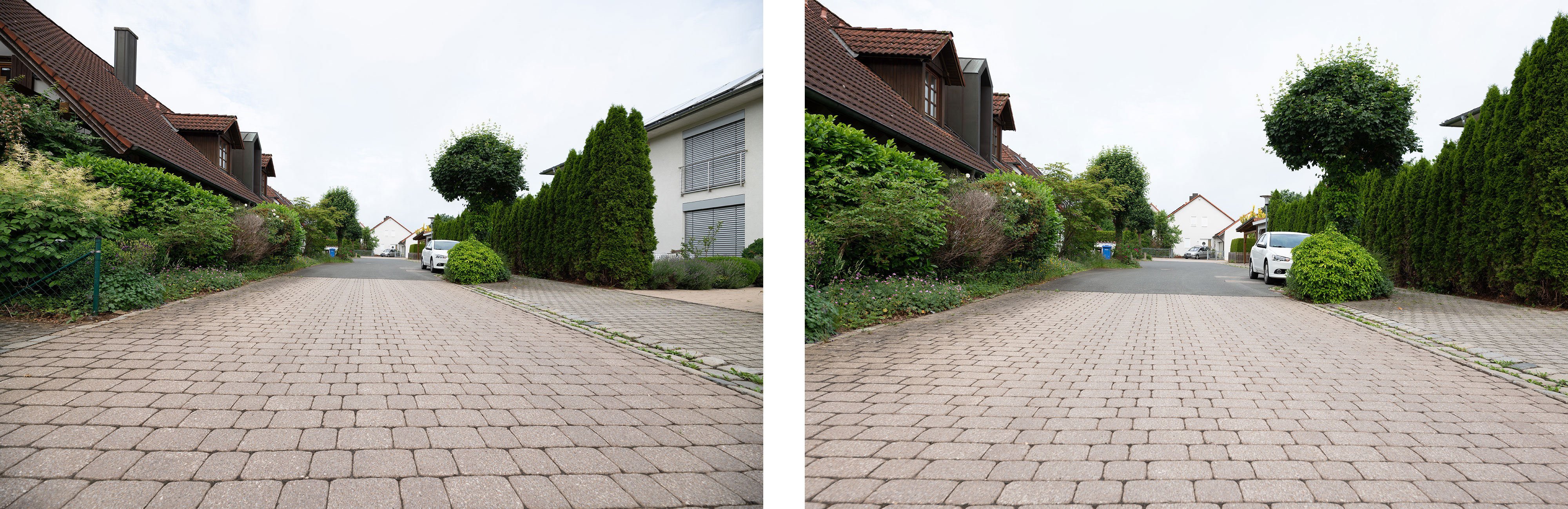
Above: Sigma 14-24mm f2.8 Art coverage on Nikon D850 (FF/FX) consistence at 14mm (left) and 24mm (right)
Next is the coverage of the Tamron 15-30mm zoom. This is what the lost 1mm at the low goal and the additional 6mm at the long terminate look like-minded:

Above: Tamron 15-30mm f2.8 VC coverage on Nikon D850 (FF/FX) consistence at 15mm (left), at 30mm (right)
Focus and zoom
Focus accuracy and repeatability is critical to consistently produce sharp shots. Repeatability (the accuracy of focussing on the same subject after recurrent focus-acquisition in phase angle detect mode) of this lens at standard settings and 24mm focal distance is pretty good (measured 97.8% in Reikan Central) with no really outliers terminated a series of 40 shots. In that respect is a higher focus variation when the lens focuses from a nearer distance towards a more distant target. This led to some shots being not optimally focused. At 24mm focal distance the lens focuses without hunting in around 0.35sec from infinity to 0.36m, which is selfsame fast, faster than the Sigma 12-24. The Tamron is of look-alike rush along, has a bettor repeatability of 99.5%, and also produced no outliers in 40 shots under the same tryout conditions.
The concentre ring has no slack/play between its movement and the focus-action and a throw of 110 degrees. Its rubberized surface is 22mm wide. The zoom ring turns finished 80 degrees and has a 12mm wide rubber superficial which is pretty slim particularly considering its rigourousness. The focus rings turns easier and can be operated with extraordinary finger. Both rings turn in the same direction as Canon users are used to but this is the finish reverse of what Nikon does. The focus resound is at the front and the zoom ring closer to the camera. I would give liked the zoom ring to exist encourage away from the body equally it is pretty walk-to to the protruding olfactory organ where approximately camera bodies have their built-in winkle. Personally I favor having the zoom ring at the front which is what the Tamron offers.

AF-cognitive operation is barely audible from the outside, and if you record video with the built-in mike the AF-driveway produces almost zero resound piece moving with only soft clicks at the start OR stop of focus-movements.
Every bit you rend stress, you'll notice some focus breathing: the figure of speech becomes less magnified at closer focusing distances. When I adjusted the focus from eternity to 0.36m on the Sigma at 24mm focal length, I measured a 3% decrease in magnification. The Tamron 15-30mm f2.8 VC shows a similar effect. So both lenses should non produce heavy focus respiration when transcription video. Same good!
Next run down my quality results!
Bridle prices on the Sigma 14-24mm f2.8 Art at Amazon River, B&H, Adorama, Oregon Wex. Or els get yourself a copy of my In Camera book Oregon treat me to a umber! Thanks!Pages: 1 2 3 4
Sigma 14-24mm f2.8 ART review
Source: https://www.cameralabs.com/sigma-14-24mm-f2-8-dg-hsm-art-review/

Posting Komentar untuk "Sigma 14-24mm f2.8 ART review"